
Fort Erie forum rejects urgent care closure, demands healthcare hub
April 20, 2026 at 9:30 PM


Fort Erie’s mayor, regional councillor, MPP and MP sat together at the Leisureplex Banquet Hall on Saturday and delivered the same message: Douglas Memorial must stay open.
At the Fort Erie Healthcare SOS forum on April 18, nurses, union leaders and lifelong residents stood up and spoke out directly to elected representatives for the continued survival of the hospital where many were born.
Every speaker backed the town’s plan to convert Douglas Memorial into a healthcare hub with continued urgent care and alternate level of care beds, and rejected Niagara Health’s plan to close the site when the South Niagara Hospital opens in 2028.
Speakers warned the closure will exacerbate ambulance delays and push thousands of additional patients into already strained emergency rooms.
Mayor Wayne Redekop outlined the town’s proposal in detail. He told the room the town has hired Stucor Construction to assess the Douglas Memorial building and Santis Health to build the business case, identifying partners and pursuing funding.
His plan calls for continued urgent care, upgraded diagnostics including a CT scanner, up to 70 alternate level of care beds, palliative beds, Indigenous healthcare space, clinics and post-secondary training.
He argued those 70 beds could absorb roughly half of Niagara Health’s non-acute bed pressure, which he said costs the organization about $50 million a year.
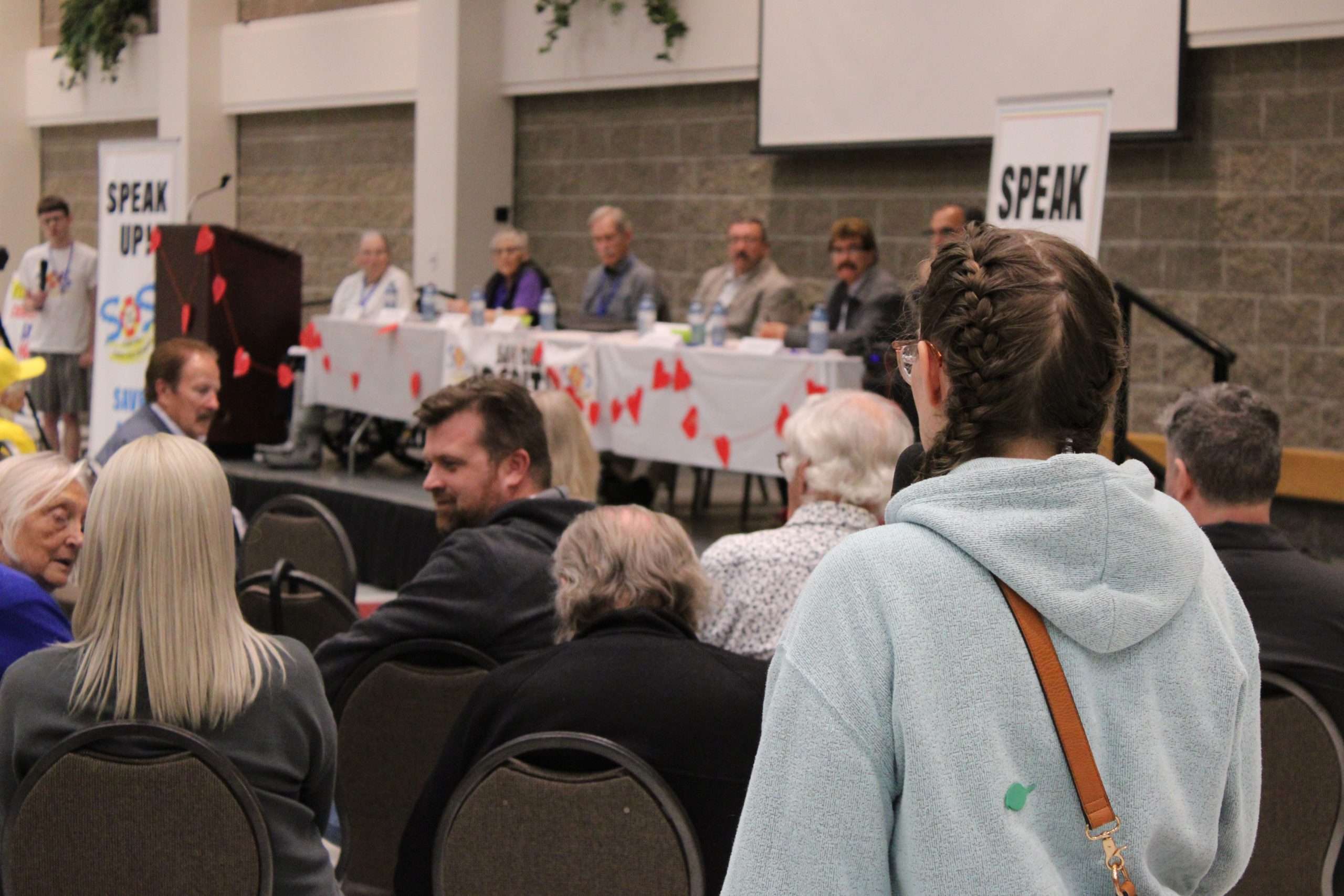 Briar Moore, a registered practical nurse at Niagara Health and SEIU representative, speaks to officials about the debilitating cuts she’s seen first hand. Credit: Andrew Hawlitzky | Fort Erie Radio
“This is a solution for Niagara Health’s acute care bed problem,” said Redekop. “This is a way that they could improve their financial bottom line.”
The town withheld its previously committed $3 million to the South Niagara Hospital after Niagara Health dropped the urgent care guarantee that accompanied the original commitment. The deal was made when Fort Erie’s population was far smaller than its current level, which has grown three per cent annually for four years and already hit projections not expected until 2031.
Ambulance calls in Niagara have climbed nearly 17 per cent year over year, with average call times stretching from roughly 86 minutes to 98 minutes, according to Regional Councillor Tom Insinna. He said 23,653 person-hours have been lost this year to hospital offload delays, with ambulance crews stranded in hospital corridors rather than available in Fort Erie.
When retired firefighter Jeff Douglas, born at Douglas Memorial, asked Insinna whether EMS can continue to absorb that load, Insinna answered directly.
“The short answer, no,” said Insinna. “Regional government has had to pull taxpayers’ dollars from the Niagara region to supplement the addition of two more ambulances. We can’t keep doing this.”
Sue Hotte, chair of the Niagara Health Coalition, told the room Niagara Health built its current strategic plan without consulting mayors or town councils, and that the population data it used was already wrong.
“Because if they had received the information, they would have known that their data was way out of sync,” said Hotte.
She warned that closing urgent care in Fort Erie and Port Colborne would send 50,000 to 60,000 additional visits into emergency rooms that are already overwhelmed.
“What in the hell are they going to do with an additional 50,000 visits?” asked Hotte. “I don’t know. That new hospital won’t be able to handle it, I don’t think.”
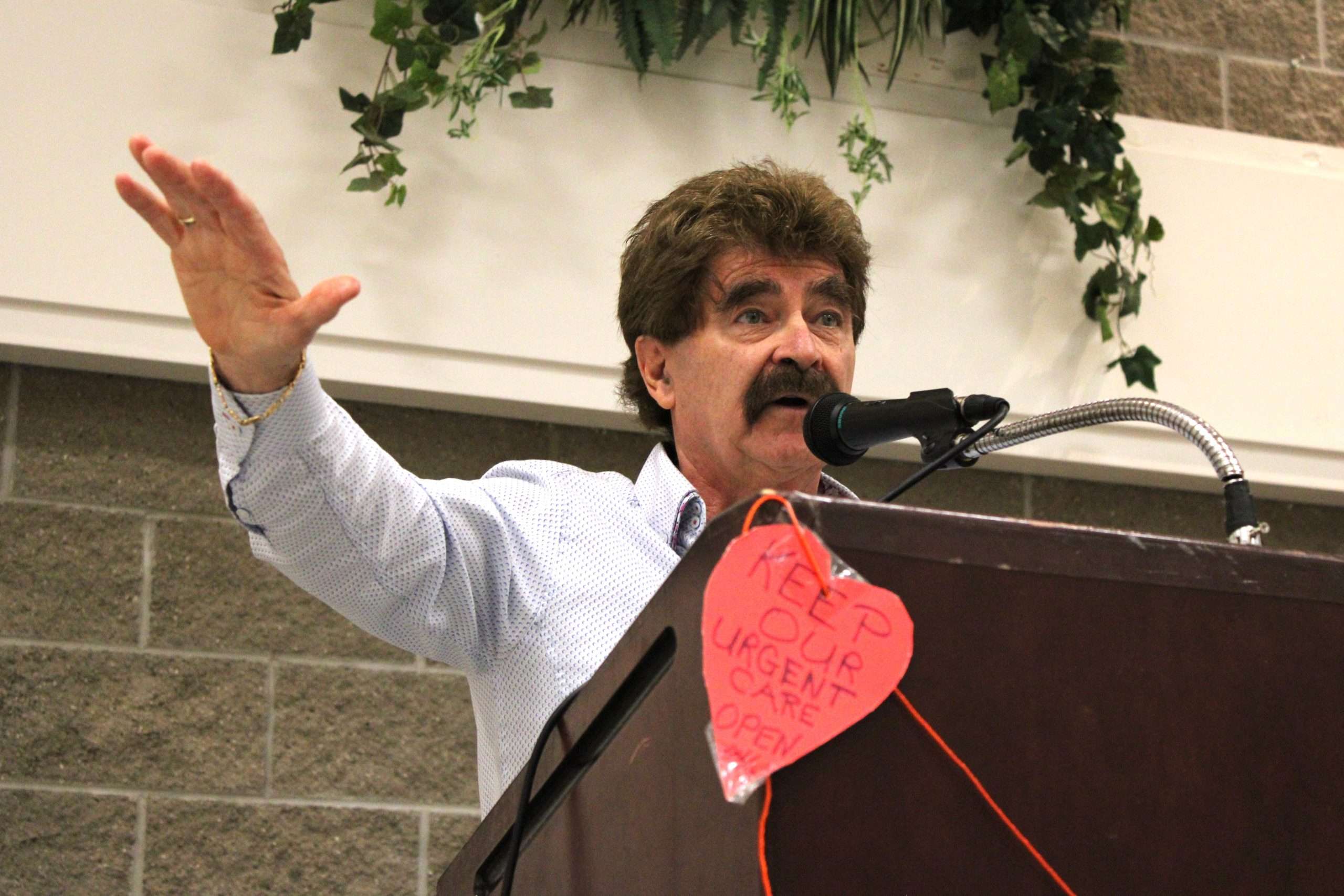 MPP Wayne Gates gives an impassioned speech about the Ford government’s privatization of healthcare in Ontario. Credit: Andrew Hawlitzky | Fort Erie Radio
MPP Wayne Gates spoke with the most urgency and got the loudest response when he argued Niagara’s hospital capacity has failed to keep pace with a population now exceeding 550,000.
“We closed six hospitals when we had 325,000 people,” said Gates. “We now have over 550,000 people, and we’re going to try to operate on two and a half hospitals and close our urgent care centres. What are you doing? It doesn’t even make sense.”
He tied the closures directly to provincial spending priorities, noting Premier Doug Ford’s office acquired a new aircraft for $28.9 million the day before the forum.
“Do you know how much that would help to make sure we keep our urgent care centre open? Or make it run 24 hours a day, seven days a week? Because that’s what we need,” said Gates.
He rejected the province’s push to privatize Ontario healthcare, arguing that mismatched spending priorities have left Niagara’s healthcare system overwhelmed.
Briar Moore, a registered practical nurse at Niagara Health and SEIU representative, detailed during the public comment period how frontline staff are being cut while administrators ignore the people who deliver care every day.
“Why are we cutting from the bottom?” said Moore. “Why are we not talking to those people who work on the front lines and asking them for suggestions? We have ideas. We have ways to fix some of the issues that they’re bringing up. We deal with it every day. They don’t.”
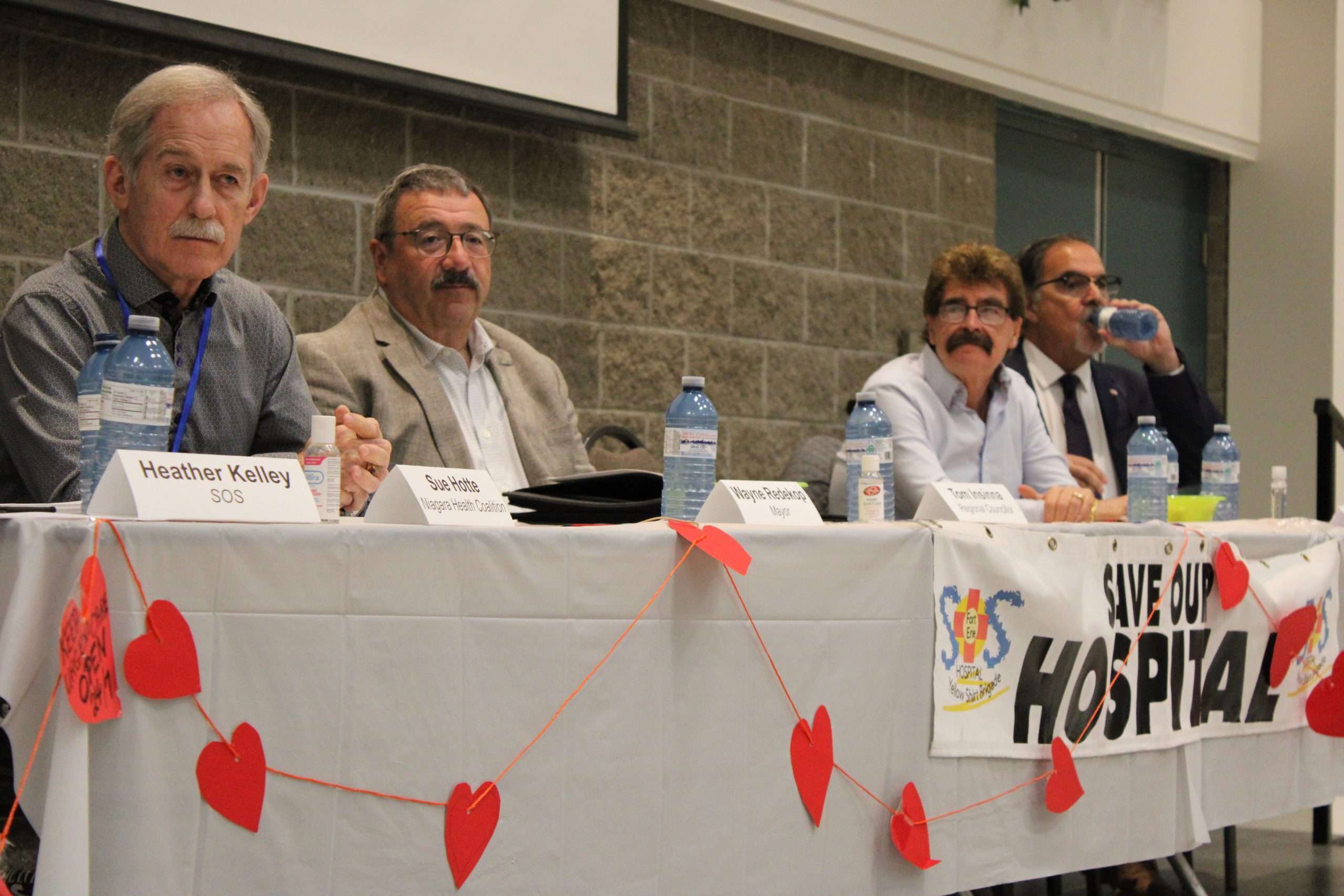 From left, Fort Erie Mayor Wayne Redekop, Regional Councillor Tom Insinna, Niagara Falls MPP Wayne Gates and Niagara South MP Fred Davies take part in the SOS Public Healthcare Forum at the Fort Erie Leisureplex on April 18. Credit: Andrew Hawlitzky | Fort Erie Radio
Fred Davies identified a potential federal opening for Douglas Memorial: the $5-billion Health Infrastructure Fund includes $2 billion for Ontario over three years, earmarked for capital projects. The kick is that the application process requires the province to control how the money flows.
“It fits perfectly for Douglas Memorial,” said Davies. “It fits perfectly, but it is going to be the province that will determine how those funds are allocated.”
Davies also argued that removing hospital designation from Douglas Memorial years ago gave Niagara Health the legal cover necessary to walk away from the site.
“By doing that one little thing–by taking the H off–that gave Niagara Health the opportunity because, strictly under its mandate, if it’s not a hospital, it’s not their responsibility,” said Davies.
Jill Lunn, whose mother-in-law Carol Munn spent her career at Douglas Memorial, spoke about what healthcare failures cost families directly.
“The truth of the matter is that when it comes to health care, it’s not a convenience or a service or some type of product,” said Lunn. “It’s a matter of life and death.”
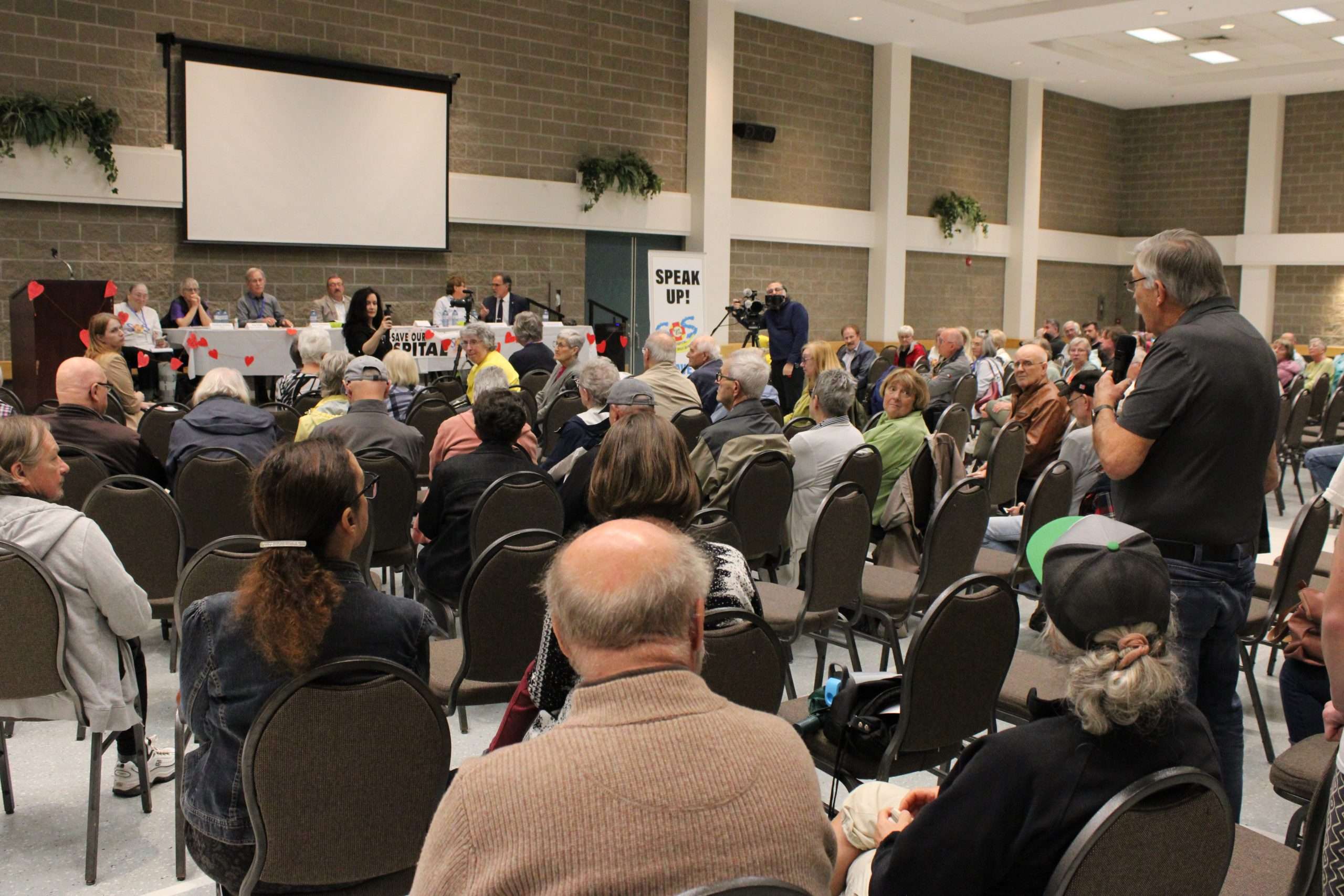 Retired Fort Erie firefighter Jeff Douglas asks whether Niagara’s ambulance system can sustain growing pressure. Credit: Andrew Hawlitzky | Fort Erie Radio
Heather Kelly of Fort Erie Healthcare SOS closed the forum by pointing to the long history of residents fighting for Douglas Memorial over the last 30 years with rallies of 5,000 people that caused negligible results. She told the room the obligation now falls on individual residents.
“We are the bosses,” said Kelly. “And don’t forget that. You have a voice. Use your voice.”
Fort Erie Healthcare SOS will attend a rally at the Pen Centre in St. Catharines on Saturday, April 25 at 11 a.m., opposing Doug Ford’s cuts to healthcare and education. Later that afternoon, the group heads to King George Memorial Park in Port Colborne at 1:30 p.m. for a rally focused on restoring 24-hour urgent care in Fort Erie and Port Colborne.
The group is also organizing a GO Train trip to Queen’s Park in Toronto on May 28, departing Niagara Falls at 6:30 a.m.

‘Eclipse or no eclipse, it was a good day’: Crowds make the best of a cloudy eclipse day
ROUNDUP | Fort Erie community events between February 6-20, 2024
Fort Erie celebrates Canada’s oldest man Burd Sisler on 110th birthday
About The Author

Andrew Hawlitzky
Andrew is a Niagara community journalist who has covered everything from local politics to annual festivals and breaking news. He works to make local news a platform where community voices lead the conversation. "If you don't like the news, go out and make some!"

Thank you Fort Erie Radio and Andrew on your fulsome coverage of the Public Healthcare Forum hosted by Fort Erie Healthcare SOS. We look forward to future engagement with the Town and Business Leaders in our community to help support Douglas Memorial