

Ridgeway Repair Café helps give broken household items a second life
November 21, 2026 at 3:47 AM


A toaster that’s stopped working, a lamp that needs rewiring or a bicycle in need of a tune-up could get a second life Saturday at Ridgeway’s Repair Café.
When Ruth Ann MacKay brought a broken vacuum cleaner to Ridgeway’s Repair Café, a volunteer took it apart piece by piece until he found the problem. The switch was broken. He couldn’t get the vacuum running again, but MacKay left knowing why it had stopped working.
Her experience illustrates what visitors can expect when the café returns Saturday, November 21, to the Beachcombers Seniors Centre in Ridgeway. From 10 a.m. to 1 p.m., volunteers at 237 Ridge Road North will help people find out what’s wrong with their household items and fix them where possible. The service is free.
Volunteers work on small appliances such as toasters, kettles, coffee makers and fans, along with lamps, electronics, toys and basic housewares. The café also offers help with sewing and textile repairs, bicycle repairs, and knife and tool sharpening.
MacKay, chair of the seniors centre, said it makes space for the café once a month and some of its members take part. She described the repair crew as a dedicated group of mostly retired men with hands-on technical experience and a fondness for taking things apart and figuring out how to fix them.
Her own vacuum was one of the items that couldn’t be repaired on site, but she’s seen volunteers rewire lamps and get plenty of coffee makers, kettles and toasters working again.
“Normally people walk away very happy because their devices get new life,” MacKay said. “They are keeping all sorts of things out of the landfills.”
Paul Ellis, a furniture maker who launched the Niagara chapter in 2024, said keeping items out of landfills is one reason for holding the cafés. Another is giving people the chance to see what goes into a repair and decide whether it’s worth ordering a part to keep something they already own.
“It adds more life to the product and pressure to manufacturers to make parts available,” he said.
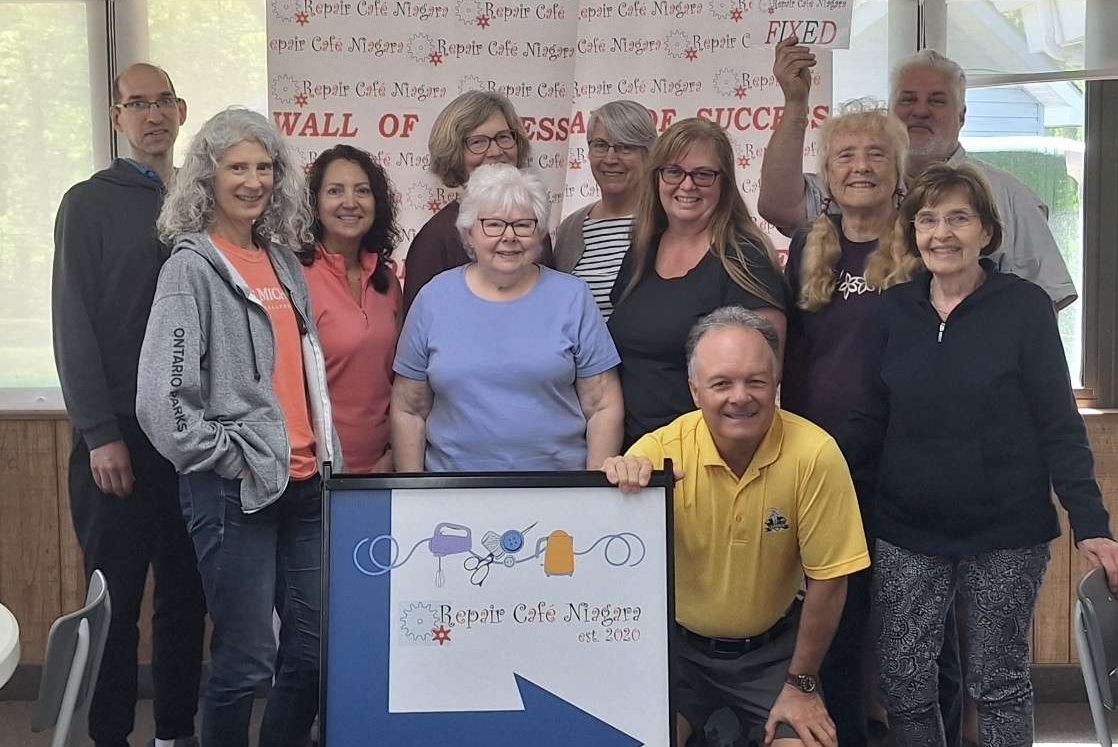 While help is free at the Ridgeway Repair Café, donations are accepted to help pay for tools and refreshments. Credit: Paul Ellis
Visitors should bring any replacement parts they know they’ll need. If the problem is unclear, a volunteer can look at the item with its owner and may be able to help track down the right part. Ellis said the owner can then weigh the price of the part and the work involved before going ahead.
People are expected to stay with their items while volunteers open them up and look for the problem. Ellis said some visitors arrive expecting to leave an appliance and come back for it later, but working alongside the person who brought it in is part of how the café passes on repair skills.
“That’s why we insist that they are there with us while we open it up and see what the problem is,” he said.
Ellis traces his own interest in diagnosing problems to childhood.
“I’ve been taking stuff apart since I was a boy, trying to figure out how they work,” he said.
One project that led him toward volunteer repair work was rebuilding a vintage high chair for a child with complex health needs. Ellis said he adapted the chair under the guidance of a doctor and a nurse and did the work for free. The experience made him think about how his training as a furniture maker could help other families.
“I just wanted to help the kid out, and his single mom,” he said.
After reading about Repair Café in a newspaper, Ellis began volunteering as a fixer with the Burlington Repair Café in Halton Region. He brought the model to Niagara in 2024. His repair work has also given him the chance to help people preserve antiques and other items that have been in their families.
The first Repair Café took place in Amsterdam on October 18, 2009. Dutch journalist and sustainability activist Martine Postma came up with the idea after her second child was born, when she began looking for practical ways to reduce household waste.
The grassroots movement grew from that idea of bringing neighbours together to repair everyday objects and share the skills to keep them in use.
In Ridgeway, the work volunteers can take on depends in part on the space. Large appliances and gas-powered equipment are outside the scope of the clinic. Ellis said he would like to hold spring and fall sessions to teach people how to maintain lawn mowers and snowblowers, but would need a site where volunteers could safely work with gasoline and oil.
For anyone unsure whether to bring an item, Ellis said a photo or two and a short description sent ahead by text, email or Facebook can help volunteers tell whether it’s something they can work on.
Ellis also credited community organizations such as Beachcombers for opening their doors to the volunteers. MacKay said the centre sees value in giving people a regular place to get help with repairs.
“We feel it’s such a valuable service,” she said.
The café is looking for more volunteers, including people who can lend a hand once or twice a year. Ellis said someone who knows how to repair lamps might come in with that skill and pick up tips from another volunteer on how to work on a rocking chair.
While the repair help is free, the café accepts voluntary donations to help pay for tools and refreshments. Coffee, tea and baked goods are typically available during the sessions.
For more information about Saturday’s café or to ask about a repair, Ellis can be reached at paulrellis@gmail.com or (905) 651-1596.
Additional information about the Repair Café can also be found at repaircafeniagara.com.


Crystal Ridge Dream Center hosts May charity dinner and record show
COPE food bank ‘seeing new clients every day’
Brain Injury Association to benefit from Coldest Night of the Year 2025
About the Author

Nathan Smelle
Nathan Smelle is a Canadian journalist, editor, and author. With more than a decade of experience in community journalism, he has served as managing editor of The Bancroft Times and Bancroft This Week, and as news editor for The Voice of Pelham.

Stay Informed