
Local train expert explores Fort Erie’s fascinating railway history
March 20, 2025 at 8:53 PM


A local train expert was a special guest at the Bertie Historical Society’s monthly meeting on Wednesday night, sharing facts about some unique pieces of Greater Fort Erie’s rail history.
Ken Jones, founder of the Niagara Railway Museum, gave a presentation that touched on his site at 21 Warren Street, but also on engines and other rail equipment long-time residents may recall, or possibly were not already aware of.
“Some people walked out with some new information they may or may not have known,” Jones told Fort Erie Radio after his presentation, which was given to more than 20 people in the community room at Fort Erie Public Library’s Crystal Ridge branch.
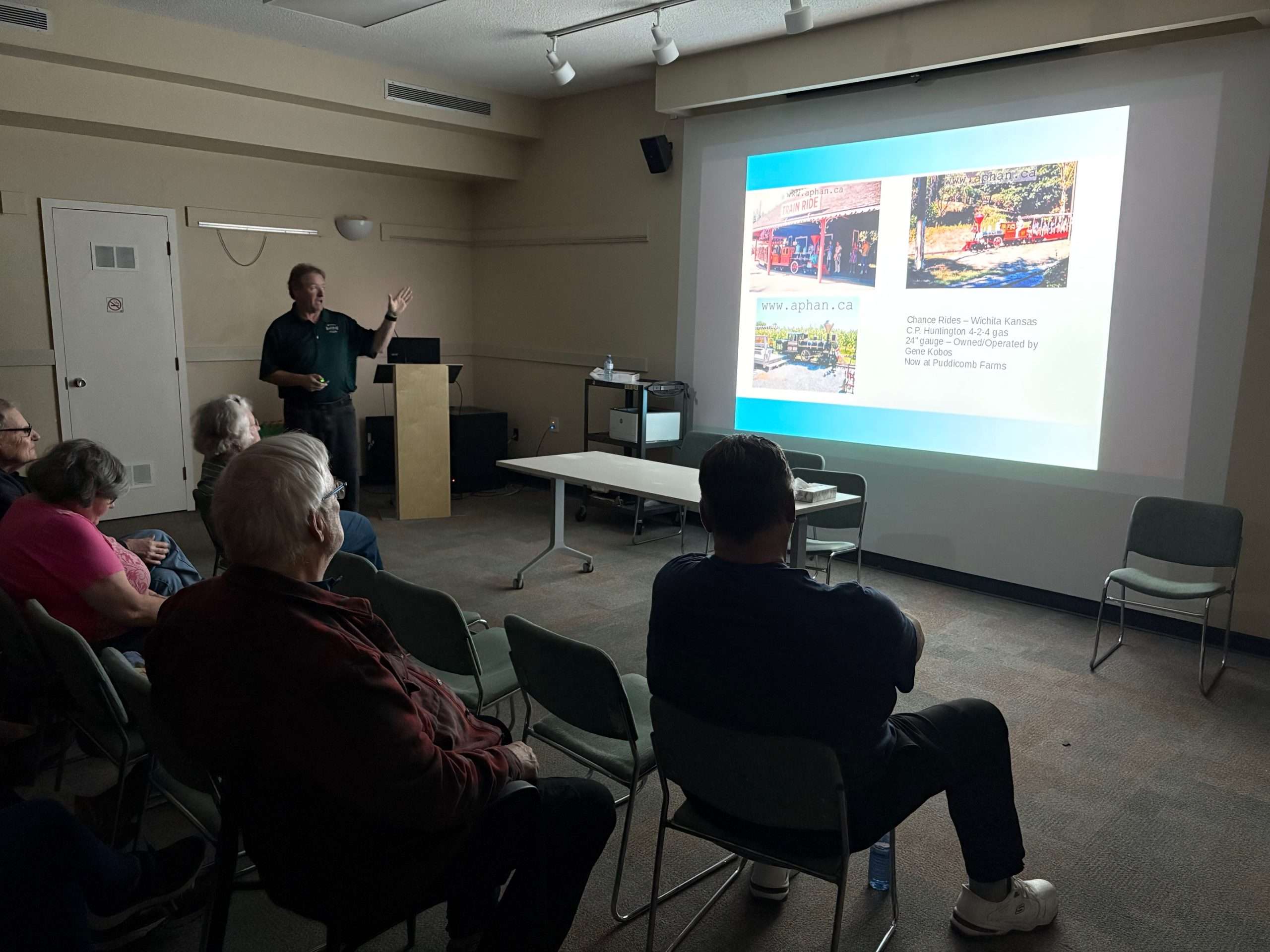 Ken Jones from the Niagara Railway Museum delivering a presentation to the Bertie Historical Society on Wednesday night. Credit: Kris Dubé | Fort Erie Radio
The train at the Crystal Beach Amusement Park, which closed in the late 1980s, was part of his presentation.
“Trains and amusement parks go hand in hand,” said Jones, who also has two steam engines from Marineland at his museum.
The train at Crystal Beach was a “narrow gauge” and was used as a ride at the park during its heyday.
He admits the people in the crowd Wednesday were “mostly older and would’ve remembered going to the park.”
He said there is still a grassy area along Erie Road that was used as a turnaround when the train was being used at the park.
But there were three used over the park’s 100-year history.
The first was a steam-powered engine, followed by one that ran on diesel, and a third that was made by a company in Wichita, Kansas, and is currently owned privately by someone in Winona, Ontario, said Jones, adding he had a chance years ago to run it when it made a stop in Niagara Falls.
Another piece of local history he discussed during the evening was a “steam dummy,” a train that transported people over the border from Bridgeburg via the International Railway Bridge before the construction of the Peace Bridge 100 years ago.
It was special because it “looked like a passenger car,” which is essentially what it was used for, but had wheels on one end and a steam-powered drive system on the other, which Jones said is unique.
“It was basically a shuttle” that brought people into the U.S., he said, likely beginning at the turn of the 20th century.
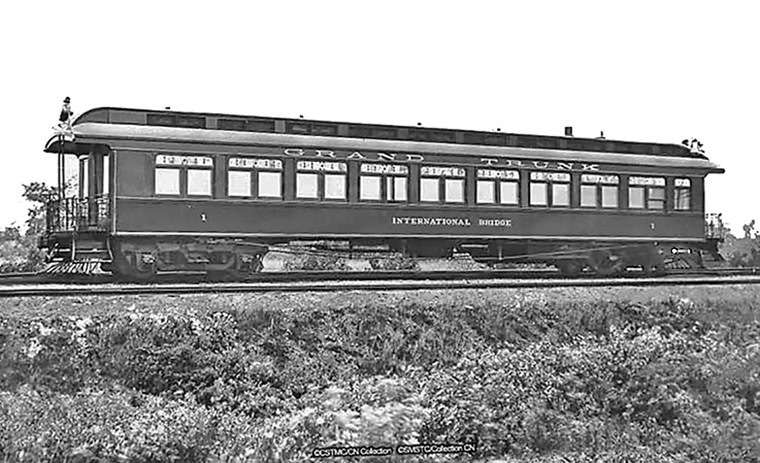 The “steam dummy,” a unique locomotive used to transport people into the U.S. via the International Railway Bridge before the construction of the Peace Bridge. Credit: Ken Jones
He also discussed the “Peg Leg” railroad, which ran between Ridgeway and Crystal Beach.
The Niagara Railway Museum reopens to the public in May, offering tours on weekends.
It operated as the Canadian National Fort Erie Diesel Shop, a facility responsible for maintenance and heavy repairs along the railway in the early 1950s until it was decommissioned in 1989. Two railcars have been converted into showrooms filled with pieces of rail history.
The museum was founded 27 years ago but moved into its Fort Erie location in 2010.
The Bertie Historical Society founded the Fort Erie Historical Museum in 1972, which became an operation of the municipality in 1987.
Vice president June Chipp said everyone was pleased with the presentation and that next month’s topic will feature staff from the Niagara-on-the-Lake Museum discussing Chloe Cooley, a young Black woman held as a slave in Fort Erie and Queenston in the late 1700s.
Siege weekend: ‘It all happened here’ on bloodiest battleground in Canada

Ceremony paying tribute to lost loved ones a chance to ‘make new memories’
Fort Erie values ‘diversity and inclusion’: Redekop at Pride event
About The Author

Kris Dubé
Kris is a veteran journalist who has worked in Niagara for close to 20 years. He is also a lifelong resident of Fort Erie, a place he plans to call home and raise his family for many more years.

Stay Informed