
Fort Erie woman beats ‘astronomical’ odds with life-saving transplant
May 20, 2026 at 3:26 AM


Erika Reece had a two per cent chance of finding a kidney that could save her, and now she helps dialysis patients face the same fear she did.
Reece, 56, spent weeks moving between Niagara Falls, St. Catharines and Hamilton hospitals after what first looked like a lingering respiratory illness was later diagnosed as Stage 4 kidney failure caused by a rare autoimmune disease.
Friends, co-workers and relatives offered to donate kidneys. None matched. Reece said the ordeal changed how she sees Niagara’s strained hospital system and the loss of healthcare services in Fort Erie.
It was spring 2022, when Reece was a busy mother of two adult sons and a young daughter working as a Canada Border Services Agency (CBSA) superintendent at the Peace Bridge when she caught COVID-19.
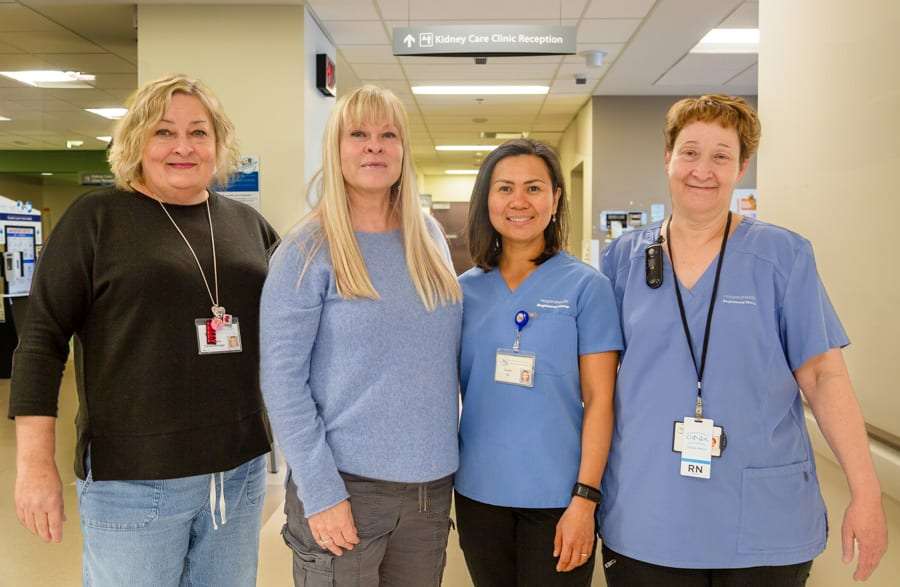 Erika Reece, second from left, with members of her kidney care team. Credit: Niagara Health
By June, she believed she was through the worst of the infection but her eyes stayed inflamed, and a bad cough lingered, though she kept driving her 12-year-old daughter to dance and kept telling her family doctor she was managing.
An ENT prescribed antibiotics for a suspected ear infection, but the drugs only made her sicker. Her ophthalmologist, Dr. Patricia Teal, examined her at a Fort Erie clinic and gave her the unexpected advice to get blood work done.
Reece went for blood work on Thursday morning before the Canada Day long weekend, after weeks of worsening symptoms.
“I was healthy and working out in May and all of a sudden, I could barely even walk,” said Reece.
By that evening, her family doctor, Dr. Michael Csanadi, had received the results: her creatinine levels were dangerously high. Csanadi, who lives nearby, drove to her house to deliver the news in person.
“My kids were sitting there, my husband, and I was just like, ‘Are you kidding me?’” said Reece. “I’m like, ‘Where should I go?’”
Reece went to Douglas Memorial’s urgent care centre first, where Dr. Kim Scher gave her intravenous fluids for severe dehydration. Scher told her she was too sick for urgent care and needed to go to Niagara Falls or St. Catharines hospital.
“I went to Niagara Falls and it was really tough because I thought I wasn’t coming out,” said Reece.
Emergency department staff took roughly five hours to admit her. Reece was first placed in an emergency cubicle beside other patients, including a man under police and corrections escort. She was later isolated because staff suspected a C. difficile infection. She spent five days in the Niagara Falls emergency department before staff moved her to a hospital room.
“That was probably one of the worst experiences in my life in Niagara Falls hospital,” said Reece. “They’re short staffed. It was just a horrible experience.”
Niagara Health nephrologist Dr. Kathleen Quinn diagnosed her with C-ANCA vasculitis, a rare autoimmune disorder that attacks the upper respiratory tract and kidneys.
On July 12, Reece was transferred by ambulance to St. Catharines for emergency dialysis, where doctors inserted a central line into a large vein in her chest while she was awake so dialysis equipment can access the bloodstream.
“I’m just like, ‘I don’t know anything about any of this,’” said Reece. “And then they start talking about dialysis, and I’m like, ‘What the hell? I don’t even understand what you’re talking about.’”
For the next two weeks, Reece went between Niagara Falls, St. Catharines and Hamilton for dialysis, immune-suppressing treatment at the Walker Family Cancer Centre and a blood-filtering treatment to remove harmful antibodies. The vasculitis went into full remission after two infusions, she said.
Reece returned home on July 17, with swollen legs and her strength gone. She forced herself out of bed within a week and started walking from her bedroom to the bathroom, then around her pool, then around her yard.
“I just kept pushing myself every day until I got my strength back,” said Reece.
The psychological recovery took years. Reece developed PTSD symptoms tied to hemodialysis and required Ativan before every session because the treatment triggered panic.
“I would spend the first half an hour hooked up to the machine, and I would just cry,” said Reece.
A psychologist who specializes in trauma among frontline workers helped her build coping techniques.
A close friend and CBSA colleague drove her to dialysis appointments after her husband returned to work, sat with her through four-hour hemodialysis sessions and held her hand during the worst stretches.
Reece kept the severity hidden from her family for three to four months because she hoped her kidney failure was temporary. Her brother had died suddenly two years earlier, and she did not want to add stress for her father, who is in his 80s. Her own mother died when Reece was 16, and she feared her daughter would face the same loss.
“All I could think of is my daughter’s going to lose her mom, and she’s only 12,” said Reece. “It was kind of like, to me, history repeating itself.”
She switched to home peritoneal dialysis after roughly six months, giving her some control over her schedule. She resumed travel and weight training, and finally felt ready to discuss a kidney transplant with her family.
“It gave me control of my life again,” said Reece. “And I was like, ‘Okay, let’s talk about transplant.’”
Sixteen friends and relatives volunteered to donate, but none matched her blood type. Both her sons share her rare B-positive blood, and her older son later asked why she had not requested his kidney, and Reece told him that was not something a mother asks of her child.
“He was at that point trying to apply for the police,” said Reece. “I said, ‘You need to take care of that first and figure out where you are in your life and take care of that.’”
Her older sister, who is A-positive, started the donation process in 2023, with the genetic similarity giving doctors some hope. Reece and her sister began planning a 2024 surgery date.
By summer 2024, that plan collapsed because Reece’s antibodies would have caused her body to reject the kidney. Doctors told her she had roughly a two per cent chance of finding any compatible living donor.
Her sister entered Canada’s kidney paired donation program through Canadian Blood Services, which runs four matching cycles a year and often produces donor chains of 30 to 60 people. Reece said she was warned a match could take two to three years.
The call came four months later, in October 2024.
“Four months later, they called me and had found me a match, and not only was it a match, it was a really small chain,” said Reece. “I found out there was only four of us in it, which mathematically, with my odds, it was astronomical.”
Her surgeon performed the three-hour transplant at St. Joseph’s Healthcare Hamilton on January 31, 2025. Reece woke from surgery and asked for a fast-food breakfast sandwich, sushi and a submarine sandwich, all foods she had been forced to avoid on dialysis for their sodium content.
Her sister donated her kidney to another recipient in the chain. Six weeks after surgery, the sister returned to full activity with three small laparoscopic scars and normal blood work.
“My sister, she’s 62, she donated, and she’s doing wonderful,” said Reece. “Six weeks after she donated, she felt completely back to normal. Her blood work is completely normal. She does all the things she used to do.”
Reece marked one year with her new kidney in January 2026 with a cruise alongside her husband, Mike. She still works from home to limit infection risk and wears a mask in busy public spaces.
The donor failures, hospital transfers and long waits during her early crisis permanently changed her perspective of Niagara’s health system. She watched elderly Fort Erie patients travel to out-of-town hospitals for dialysis treatment the town no longer provides.
“I never realized how bad our health system is here in Niagara,” said Reece. “It really opened my eyes.”
Reece lives only a short walk from the former Fort Erie hospital which backs onto the field behind her property. Her oldest son was among the last babies born at the hospital before the maternity ward closed.
The Douglas Memorial site has lost most of its acute services, and Niagara Health is moving toward a three-site model that draws Fort Erie residents to Niagara Falls and St. Catharines for hospital care.
Currently, Fort Erie council is weighing a motion to formally request the resignation of the Niagara Health board and chief executive Lynn Guerriero. Councillor Tom Lewis deferred the motion at the town’s April 27 meeting to late August while talks continue on a Reimagining Douglas Memorial plan with Niagara Health and Queen’s Park.
The plan would keep an urgent care centre, diagnostic imaging, transitional and palliative care, primary care and medical clinics in Fort Erie. The town is withholding $3 million of a $10.5 million commitment to the new South Niagara Hospital while negotiations continue.
Reece praised her transplant doctor, surgeon, the nephrology ward at St. Joseph’s Healthcare Hamilton and the nursing teams who handled her recovery.
“The transplant experience and the care that they have there was unbelievable,” said Reece. “My start with the health system was really rocky, but once I got into the treatment and everything, my experience was incredible.”
She said one of the hardest parts for kidney patients and their families is the mental trauma that can follow diagnosis, dialysis and transplant planning. Reece said patients are often prepared for the physical treatment before they understand the fear, anxiety and family strain that can follow.
“People don’t discuss that,” said Reece. “They talk about the physical aspect of kidney disease, but they don’t often talk about the mental aspect.”
Reece now speaks twice a year to Niagara Health kidney patients through education sessions about dialysis and transplant options. She challenges the assumption that organ failure follows poor choices, since hereditary polycystic kidney disease is one common cause.
“If you can, do a transplant. Just skip the dialysis completely. If you have time, find yourself a donor because that is by far the best option. It’s life-changing. It’s a second chance at life,” said Reece.
She urged more people to consider becoming living organ donors, saying many patients waiting for kidneys “have done nothing to contribute to their bad health” and simply “got dealt the cards that life gave them.”
More than 4,000 Canadians were waiting for an organ transplant at the end of 2024, according to the Canadian Institute for Health Information, and about 70 per cent were waiting for kidneys.
“You can literally save someone’s life,” said Reece.

Ice boom installation delay sends heavy ice down Niagara River

Severe weather leaves many without power for hours

Fort Erie bluesman René Huard releases single from November album
About The Author

Andrew Hawlitzky
Andrew is a Niagara community journalist who has covered everything from local politics to annual festivals and breaking news. He works to make local news a platform where community voices lead the conversation. "If you don't like the news, go out and make some!"

Great article Andrew!! I will be looking forward to more of
your in depth news articles! Charlene Heckman Resident at THE WILLOWS in Fort Erie