
Ford open to amalgamation as Fort Erie pushes back on Gale’s plan
February 27, 2026 at 4:58 AM


Premier Doug Ford left the door open to restructuring the region’s municipal government during a February 25 news conference in Niagara Falls, including amalgamation.
Ford set conditions that any proposal must originate locally and carry broad political and public support as Niagara’s mayors face a March 3 deadline to respond to a governance review launched by Niagara Region chair Bob Gale.
“If it’s going to go, then it has to be from Niagara, by Niagara. It has to have approvals from the majority of mayors, has to have approval from the majority of the elected officials,” said Ford.
The Town of Fort Erie has stated its opposition and intends to file a code of conduct complaint against Gale for overstepping his authority. Council challenged Gale’s process on February 23 and pressed for a business case, costings and public consultation before any structural changes are made.
Mayor Wayne Redekop and Regional Councillor Laura Ip introduced a motion to committee February 26 for Gale to refrain from any further review of regional governance, which passed 17-12. Ip said amalgamation would have a “multi-generational impact” in a statement made on Thursday evening.
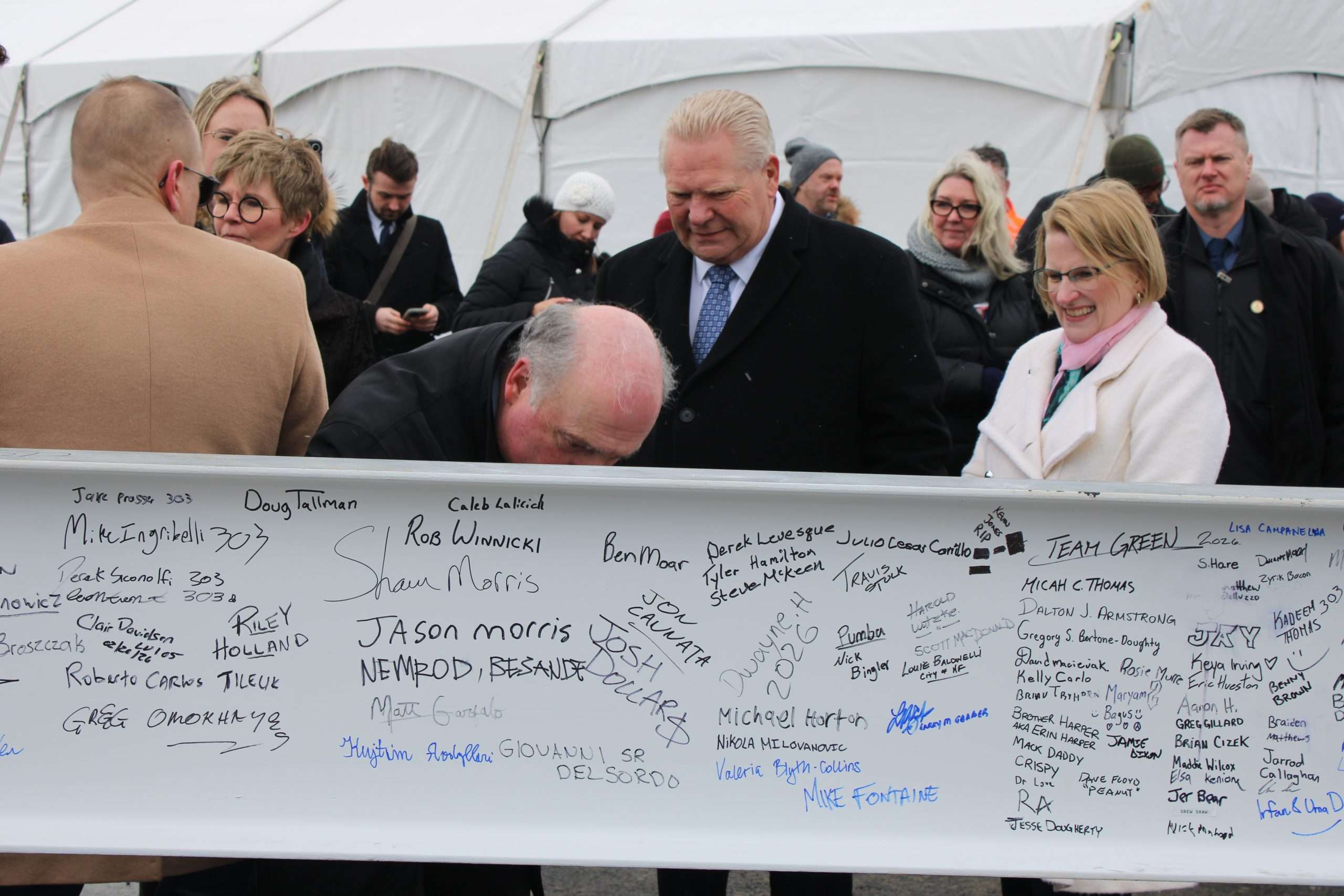 Premier Doug Ford watching Niagara Regional Chair Bob Gale sign the final structural beam installed at the South Niagara Hospital on February 25. Credit: Andrew Hawlitzky | Fort Erie Radio
Ford compared Niagara’s 126 local politicians to the province’s 124 MPPs as well as Hamilton’s 16 councillors and Toronto’s 26, saying municipal politicians can’t be expected to cut their own seats.
“It’s like asking the turkeys to vote for Thanksgiving,” said Ford.
When asked by reporters about research that suggests municipal amalgamation does not deliver cost savings, Ford rejected the premise and said he had never seen studies reaching that conclusion.
He said larger governments can cut costs by standardizing services and reducing duplication across multiple councils and administrations, and he dismissed the idea that amalgamation does not save money. He tied that claim to Niagara’s recent regional tax levy increases which saw taxes rise about 25 per cent over a single four-year council term.
“I’d like to see a majority of mayors agree and hopefully 70, 80 per cent of the population agree. If they want one city, if they want four cities, whatever they decide, I’ll take the lead from them,” Ford said.
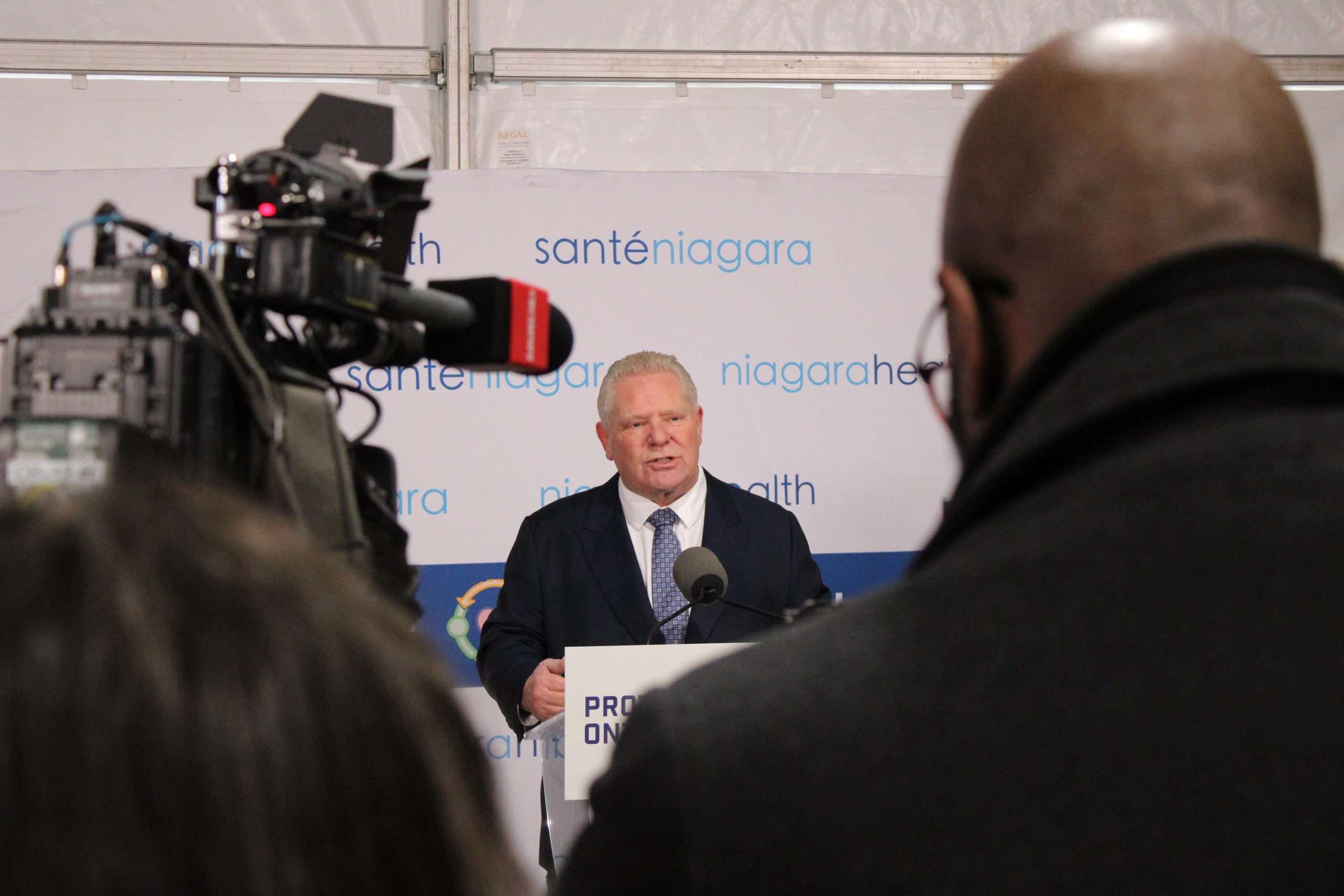 Premier Ford responded to several questions from reporters at a press conference in Niagara Falls on Wednesday, saying he was open to the possibility of Gale’s proposed amalgamation of Niagara. Credit: Andrew Hawlitzky | Fort Erie Radio
Gale’s push became public after letters dated February 5 and distributed February 19 went to Ontario Municipal Affairs and Housing Minister Rob Flack and Niagara’s 12 mayors, with Gale asking for feedback by March 3.
Gale wrote that Niagara’s two-tier structure creates overlap and weak fiscal control, with recent regional levy increases of about seven per cent, 9.6 per cent and 6.3 per cent and a deferred capital backlog of about $2.7 billion.
Fort Erie council confronted Gale in a council meeting on February 23 after learning he sent the letters without a mandate from regional council. Under questioning from Redekop, Gale confirmed the province gave him no formal direction with his appointment as regional chair.
Fort Erie’s challenge also focused on the lack of information behind Gale’s request and the short consultation window.
“Do you understand what data is?” asked Redekop.
“Facts,” said Gale.
“So, you have nothing currently,” said Redekop.
“Nothing in the last year. That’s why I’m submitting it to the government for their decisions,” said Gale.
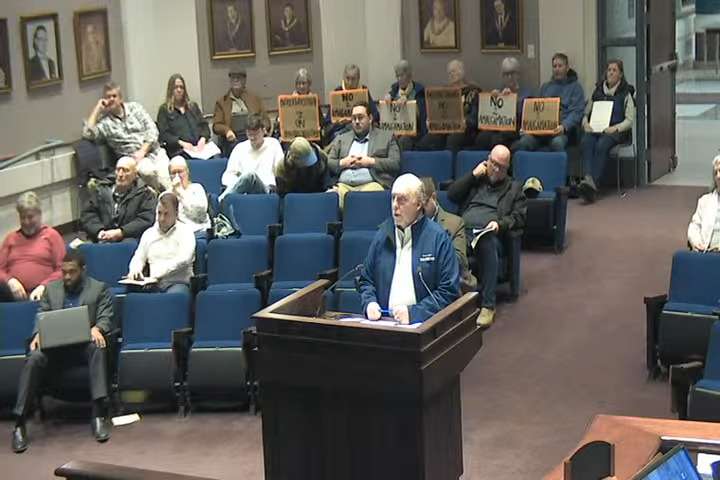 Niagara Regional Chair Bob Gale answers questions from Fort Erie council during a regular meeting on Monday. Credit: Town of Fort Erie | YouTube
Councillor Ann-Marie Noyes pressed Gale on whether Queen’s Park would be told that his recommendations lacked proof of savings.
“I will not put that in there,” said Gale. “I will submit (to) them all the information I have, and they will decide if it’s beneficial to go to a four-city or one-city model or reduce politicians.”
“If I was coming forward with the drastic change that you’re recommending, my answers wouldn’t be a lot of ‘I don’t knows,’ a lot of ‘I’m not aware of it,’” said Noyes.
Gale said he had not done any consultation, that he only met with staff and decided it was his time to act. He clarified that approaching Minister Flack and sending the letters were his ideas after touring and hearing from taxpayers and businesses.
According to Redekop, consolidation would likely shift financial burdens between municipalities, including the risk that Fort Erie taxpayers could absorb debt carried elsewhere in the region.
Council’s objections also focused on challenging the actual drivers of regional tax increases, including policing costs.
According to figures presented by Redekop to Gale, Niagara Regional Police operating costs run about $136 million and policing accounts for most of the region’s 2026 levy increase, with further large increases projected for 2027 and 2028.
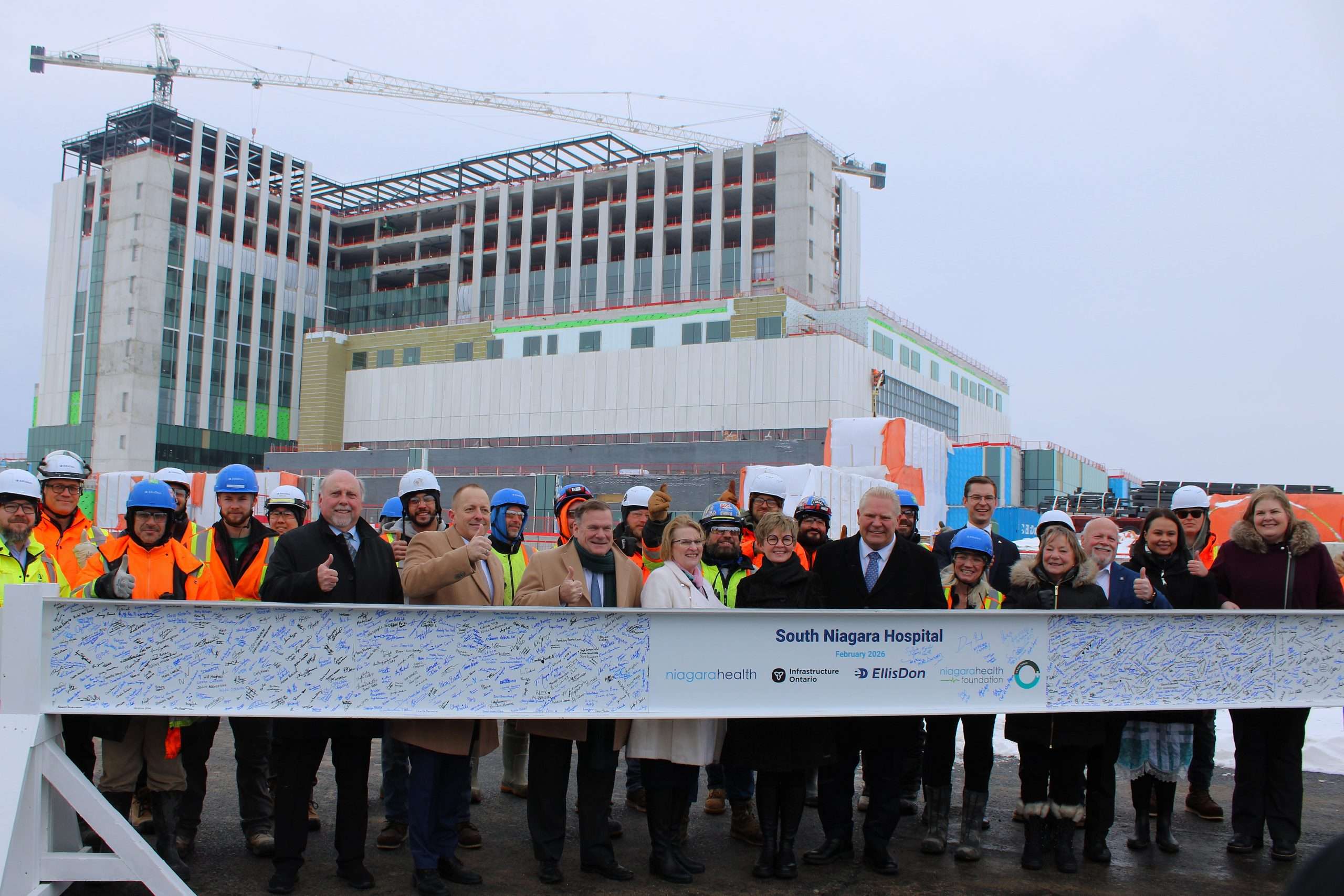 Doug Ford posing with several Niagara politicians, including Bob Gale on the left, and construction workers in front of the South Niagara Hospital, expected to be complete in summer 2028. Credit: Andrew Hawlitzky | Fort Erie Radio
Other Niagara municipalities have signalled sharply different positions in public statements and coverage.
Niagara-on-the-Lake Lord Mayor Gary Zalepa has opposed any proposal that would see the town absorbed through amalgamation, calling it “existential,” while St. Catharines Mayor Mat Siscoe has supported a four-city model of amalgamation.
The immediate next steps remain tied to the March 3 deadline. Niagara’s mayors must submit written feedback to Gale by that date and Gale has indicated he intends to forward initial recommendations to the province in the first week of March.
Councillor Tom Lewis pressed Gale on what, exactly, municipalities were being asked to respond to.
“You said you asked us to look at a plan. Where is the plan?” asked Lewis.
“The plan will go up to the province,” said Gale.
“No, but you just said you’ve asked us to look at a plan. Where is the plan?” asked Gale.
“Look at an idea then. The wrong word is ‘planning,’” Gale responded.
Fort Erie has indicated it will communicate concerns regarding Gale’s conduct directly to Ontario Housing Minister Flack based on the town’s legal review.

Bay Beach again deemed unsafe for swimming
Boat stranded ashore at Bay Beach has finally been removed
Niagara River trail repairs and restoration begin Monday
About The Author

Andrew Hawlitzky
Andrew is a Niagara community journalist who has covered everything from local politics to annual festivals and breaking news. He works to make local news a platform where community voices lead the conversation. "If you don't like the news, go out and make some!"

Stay Informed