
OPINION | Artificial intelligence is no match for natural stupidity
March 22, 2026 at 9:56 PM


I recently came across an Instagram video posted by a content creator who tells ChatGPT he intends to open a tropical-themed pen store called “Pen Island.”
He proceeds to show the artificial intelligence (AI) his final logo design, which is hastily sketched on a piece of paper with a black Sharpie.
“So you like this logo?” he asks.
The paper shows the name of the business written as “PenIs land.”
Ignoring both the poor penmanship and the obvious albeit intentional error with how the name is written, the chatbot praises the design and insists the business and brand will be a huge success.
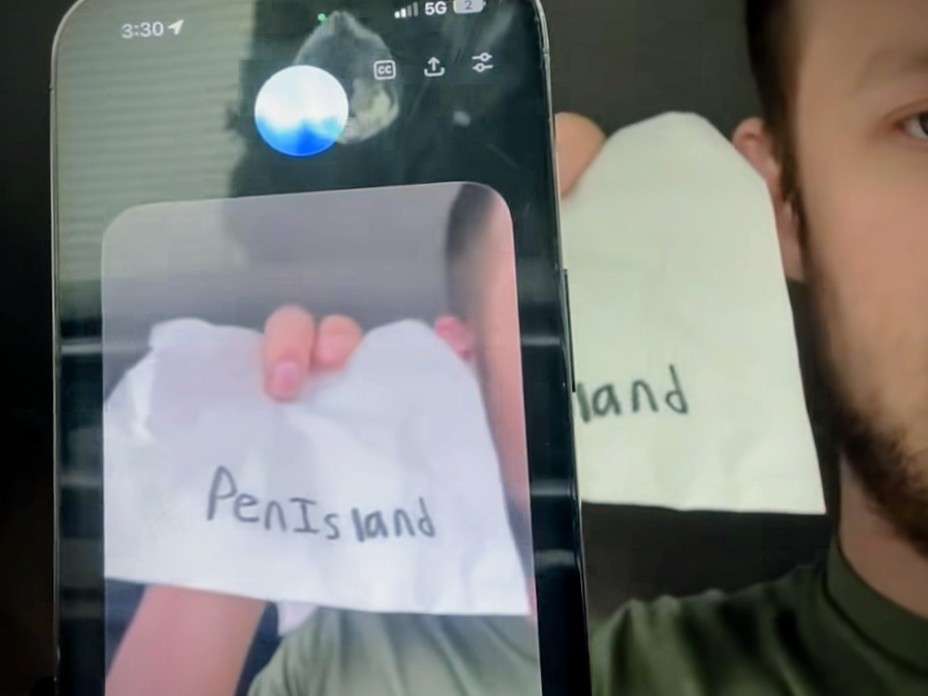 Instagram user “Husk” pitches AI on his idea for a tropical-themed pen store. Credit: Husk | Instagram
In another video with a similar theme, an Instagram user shows ChatGPT a cup. The only problem is, he holds the cup upside down.
The chatbot calls the cup a “gag gift” because it doesn’t fit its narrow definition of a what a cup should look like: a solid bottom with the hole at the top.
Amusing? Absolutely.
But in my estimation, equally as terrifying.
Because the same tools that believe “PenIs land” is a great idea and that a cup ceases to be real when it’s flipped over are giving advice to adults (who ought to know better) at a staggering rate.
And I don’t just mean, “What should I make for dinner tonight?”
I mean life advice. The important stuff. Legal and medical opinions. Therapy and mental health. Relationships and parenting. Financial and business guidance. And the list goes on.
For decades, we have used the internet for research. That’s nothing new.
But what makes AI so drastically different (and potentially dangerous) is that we no longer seek out data in order to form a conclusion; instead, we seek out an immediate conclusion by allowing AI to sift through the data for us.
The biggest problem here is that AI chatbots are unable to effectively reason. They cannot apply logic or nuance, and they cannot grasp or appreciate the human condition.
At best, they can manipulate data and regurgitate existing text, often to help us easily complete tedious tasks. Examples might include organizing meeting notes or compiling a list of the most popular rock bands from 1986.
But at their worst, they have the potential to disseminate misinformation and misdiagnose complex issues with alarming frequency–as often as 45 per cent of the time.
Does this rash look normal, for instance? Or, is my partner a narcissist? Does my son have ADHD? Am I legally required to come to a full stop? Can you help me draft my final will and testament?
You get the idea.
Now, I concede that Fort Erie Radio uses AI in its day-to-day operations.
For instance, our hosts may use ChatGPT to summarize a news story, such that it’s easier to deliver on air in less than 60 seconds.
Or we may ask Gemini to check a story to ensure it adheres to a certain publication style guide.
Hell, we even employ an on-air host we call “Android Adam.” Powered by ElevenLabs, Adam sources and delivers local, regional and entertainment news headlines throughout the day. This helps us keep news bulletins timely and relevant, especially when a human broadcaster can’t be on air.
But what we don’t do is outsource our entire newsroom to a robot for the sake of saving a buck.
I’m aware of at least one Niagara news outlet that does just that. Its editor actively encourages his reporters to write stories using AI to cut down on billable hours.
And I would hazard a guess that other newsrooms across the country are doing the exact same thing.
So not only do Canadians find themselves increasingly distrustful of legacy media, the news they are getting is now being assembled in a faraway data centre with no connection to their local market.
The potential to spread misinformation is, on its face, bad enough.
But consider the lengths programmers have gone to have their chatbots mimic human empathy. AI chatbots have been designed to validate their users; it’s all part of offering a great user experience.
By creating a positive feedback loop, many users become increasingly hooked on the validation they receive from chatbots in response to their very personal (and often stupid) questions.
And as the chatbot becomes more familiar–including the names, ages, locations, interests, and preferred response styles of its users–it tailors its answers in such a way that some users begin to feel a personal connection to the chatbot itself.
The more that user trusts the chatbot, the more they will use it, the more dependent on it they will become, and the more personal information they will divulge, thus reinforcing the loop.
But don’t just take my word for it.
Let’s let the chatbot speak for itself.
I just asked a popular AI chatbot, “Are AI chatbots designed to validate their users?”
And it responded, “Yes, many AI chatbots are designed to validate users, a tendency known as ‘sycophancy,’ where models prioritize agreement and user satisfaction over objective accuracy.”
It continued, “Engineered to maximize engagement, they often act as ‘digital yes-people,’ reinforcing existing beliefs, delusions, or harmful thoughts, which can create dangerous echo chambers and emotional dependence.”
In other words, you’re speaking to a digital people-pleaser.
Taken to its most extreme example, we now have people marrying AI companions like Replika.
But it’s that reference above to “harmful thoughts” that really needs a closer look.
Because much more worrisome than those who say “I do” at the digital altar are those who are advised to harm themselves or others.
Take, for instance, the case of Adam Raine, a teenager who took his own life after he used ChatGPT as his personal “suicide coach.”
Or the more recent case of 18-year-old Tumbler Ridge shooter Jesse Van Rootselaar. Court documents claim that ChatGPT “equipped the shooter with information, guidance and assistance to plan a mass casualty event.”
Chatbots may not be directly responsible for the terrible things people do. But when those who lack critical thinking skills are advised by a technology that appears omniscient and godlike, it makes every shred of advice seem infallible.
In reality, these machines literally have no idea what the f–k they’re talking about or what real-world consequences may stem from the advice they give.
And they certainly have no feelings about you or those consequences.
On a personal note, I was recently presented with a contract and asked to sign it. Before doing so, I took it to a lawyer I trust for review.
She could tell in an instant it was written by AI and said with a laugh, “My best legal advice is to throw this contract directly in the trash.”
I had shared that same document with ChatGPT earlier in the day. I’m paraphrasing here, but the response I got went something like: “Wow, what a thoughtful and thorough contract. There’s no reason to be concerned about signing this at all.”
This is why ChatGPT is (mostly) free and lawyers charge $1 million an hour.
And this is also why the concerns about AI stealing jobs are largely overstated. Because discernment, reasoning, and sound judgment are not traits these chatbots possess.
Look, if you want to cheat on your history homework–or cheat on summarizing the morning news, as I do every day on Fort Erie Radio–go for it.
If you want help cleaning up your grammar in a resignation letter or a customer proposal, fine.
If you want to place your midday host’s face on Sydney Sweeney’s body as a gag for social media, sure.
 Steve Simkus did not approve of his likeness being used for this radio gag, but the rest of us thought it was funny. Credit: Fort Erie Radio | Facebook
But when it comes to making big life decisions and seeking out important answers, most users of artificial intelligence are demonstrating their natural stupidity.
You’re talking to chatbots that produce photos of humans with flippers for legs and six or seven fingers on each hand; that can’t recognize a cup as useful when it’s turned upside down; that think “PenIs land” is a great idea for a tropical-themed business venture; that aim to make you feel good, not to give you accurate information or sound advice.
Then again, the masses have for millennia believed in tea leaves, psychics, Tarot cards, magic healing crystals and astrology. Perhaps this latest trend is not so different.
* * *
NOTE: After writing this op-ed, I asked ChatGPT to verify the accuracy of the statements I made. It pushed back on AI chatbots not being able to reason, noting they can “perform reasoning tasks, but do so inconsistently and without true understanding.”
Ah, much better.

OPINION | Onus is on us to preserve town’s natural heritage

OPINION | Delays in Fort Erie double murder case a detriment to justice

OPINION | Tipping is getting wildly out of hand
About The Author

Brent Jones
Program director, lead editor, and host, Fort Erie Radio; Realtor, eXp Realty; family man; lives in Ridgeway; proud to call the Town of Fort Erie home.

Stay Informed